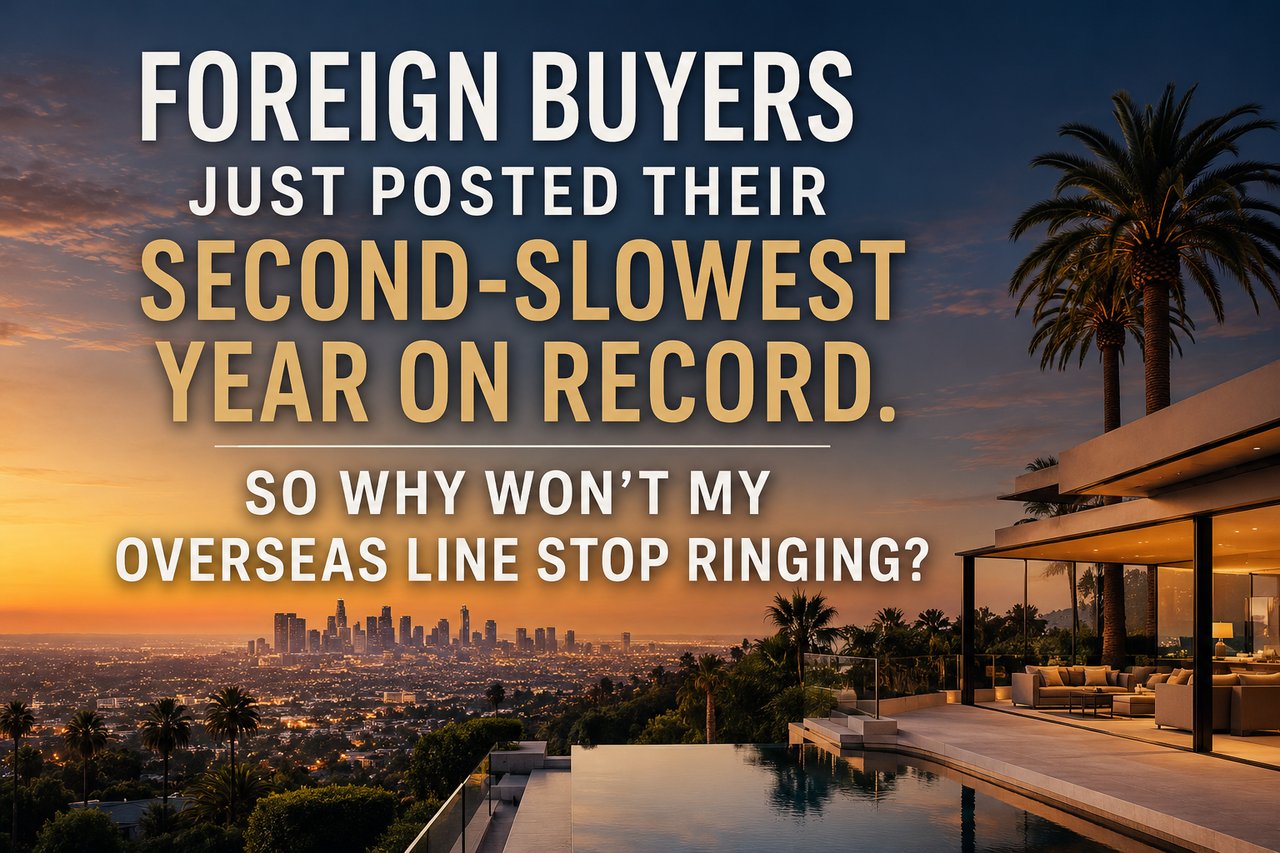
Foreign Buyers Just Posted Their Second-Slowest Year on Record. So Why Won’t My Overseas Line Stop Ringing?
Here’s what the market is actually doing right now.
The National Association of REALTORS® released its 2026 International Transactions report on July 29, and the headline was brutal.
Foreign buyers purchased $45.3 billion of U.S. existing homes between April 2025 and March 2026 — down 19.1 percent in dollars and 14 percent in units, to 67,100 homes.
That is the second-lowest transaction count NAR has recorded since it started tracking in 2009.
If you only read the headline, you’d conclude the international buyer left Los Angeles.
I’ve been on the other side of that assumption all summer.
The international buyer didn’t leave. A specific kind of international buyer left — and the one who stayed is writing bigger checks than ever.
The National Retreat Is Real. The Los Angeles Retreat Is Not.
Start with where that money actually landed.
Florida took 20 percent of all foreign buyers. California took 19 percent — essentially a photo finish, and more than Texas, New Jersey, and Georgia combined.
Now look at the composition.
Canada came back as the top country of origin at 16 percent of purchases, buying 10,700 homes for $5.2 billion. Mexico was second at 14 percent.
But China placed third by unit count at 11 percent — 7,400 homes — and still generated the single largest dollar volume in the country at $7.6 billion.
That’s an average purchase price of roughly $1 million, against a national foreign-buyer median of $465,000.
NAR Chief Economist Lawrence Yun said the quiet part out loud in the release: Chinese buyers “spent the most dollars because they bought higher-priced homes, specifically in California.”
That single sentence is the whole story.
The volume buyer went home. The trophy buyer stayed, and concentrated.
Two Different Foreign Buyers, One Misleading Headline
Most agents won’t tell you this, but the report contains a split that explains everything.
Foreign buyers already living in the U.S. — recent immigrants and visa holders — bought 37,600 homes for $21.8 billion.
Buyers living abroad bought fewer homes — 29,500 — for more money: $23.5 billion.
Run the math.
The buyer flying in from overseas spent roughly $797,000 per home. The buyer already living here spent roughly $580,000.
Fewer transactions. Larger tickets.
That is not a market losing interest. That is a market where the tourist-adjacent, second-home, mid-price foreign buyer got squeezed out by prices and rates, while the capital-preservation buyer kept moving — and moved upmarket.
Los Angeles sits directly in the path of the second group.
Following the January 2025 wildfires, international interest in Los Angeles luxury spiked to 18.2 percent of all luxury home searches in the metro by December, according to Realtor.com data reported by The Real Deal.
Agents across the city describe offshore clients arriving with $50 million-plus budgets, favoring large modern estates and new construction, and paying cash.
Realtor.com’s listing-view data has Canada leading international interest at 29 percent, followed by the U.K., Australia, Germany, and Mexico.
Why Here, and Why Now?
Two forces are doing the work.
1. Relative Value
This sounds absurd until you run the comparison a global buyer actually runs.
In March, Los Angeles ranked as the second-most expensive luxury market in the country, with entry-level luxury starting around $4.3 million — more than three times the national median.
Painful by American standards.
But Douglas Elliman’s Victor Currie put it to Realtor.com plainly: against London, Sydney, or Hong Kong, we read as a relative bargain.
A buyer comparing a Bel Air estate to a comparable address in Central London is not looking at our price with American eyes.
2. The Balance Sheet Underneath California
California recently surpassed Japan as the world’s fourth-largest economy, with GDP above $4 trillion, and has grown roughly 40 percent since 2019 — outpacing China’s 32 percent over the same window.
Global capital doesn’t chase weather.
It chases durable economies with deep legal protection for property.
We happen to have both, plus the weather.
What This Means If You’re Transacting
For Sellers at the Top of the Market
48 percent of foreign buyers paid all cash, versus 28 percent of all existing-home buyers.
When you’re evaluating offers on an eight-figure property, an international bid is disproportionately likely to arrive without a loan contingency and without appraisal risk.
That is worth real money in certainty, and it should change how you weigh a slightly lower number against a cleaner close.
It should also change how the property is marketed:
- Currency-aware pricing context
- Video that survives a first showing conducted over a screen from Singapore
- A listing built for someone who may make a decision before ever standing in the room
For Buyers
Understand which lane you’re competing in.
At the median, foreign demand has genuinely thinned, and you have room.
Above roughly $10 million in Bel Air, Beverly Hills, Malibu, and the Palisades, you are competing against cash from abroad that is not rate-sensitive and not in a hurry.
Bringing a rate-dependent offer into that fight without a strategy is how good buyers lose good houses.
The Bottom Line
I don’t just list properties. I position them — and increasingly, I position them for an audience that isn’t in this country.
If you’re weighing a sale, a purchase, or just want an honest read on where your specific address sits in all of this, reach me directly at [email protected] or (818) 561-1600.
Amir Jawaherian
The Agency | CA DRE# 01899893
Sources
National Association of REALTORS®, 2026 Profile of International Transactions in U.S. Residential Real Estate (July 29, 2026).
The Real Deal, “Foreign luxury home buyers flock to LA as billionaires exit” (April 8, 2026), citing Realtor.com data.