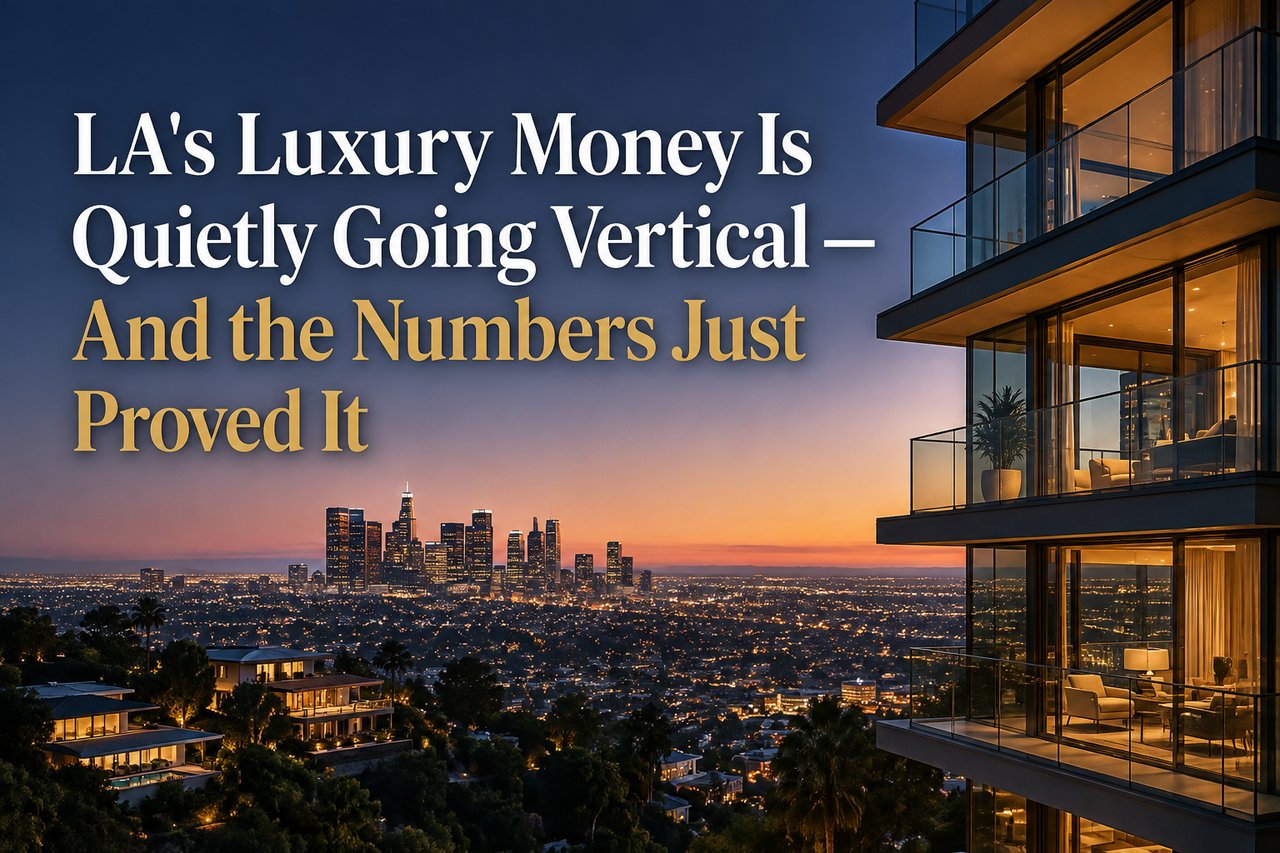
LA's Luxury Money Is Quietly Going Vertical — And the Numbers Just Proved It
For twenty years, the story of wealth in Los Angeles was told horizontally.
Gates. Hedges. A long driveway. An acre you didn't have to share with anybody.
The trophy was land. The flex was distance.
Here's what the market is actually doing right now: a meaningful slice of that money has started buying altitude instead of acreage.
Condominium sales across Los Angeles jumped 22 percent in the second quarter compared with the first, according to The Real Deal's reporting on research compiled by Compass.
That's not a rounding error, and it's not simply a soft single-family market making condos look good by comparison. It's a real move in a segment that spent the last two years being written off as the weak link in LA real estate.
Most agents won't tell you this: the condo market they dismissed is the one outperforming right now.
Westwood and Century City Are Leading the Charge
By pure deal count, the Westwood/Century City corridor led the city.
There were 147 condo sales there in Q2 at an average price of roughly $1.5 million, or about $838 per square foot.
Sit with that average for a second, because it's the most misread number in the report.
Roughly 1,800 square feet in a full-service Wilshire Corridor building for $1.5 million is not a luxury statistic — it's a volume statistic. The corridor's engine is one- and two-bedroom units in doorman buildings between $1 million and $2 million, and that engine is running hot.
The luxury tier sits well above it and moves on entirely different logic.
At Park Elm, the residential component of Century Plaza, a three-bedroom closed at $10.7 million in July, in a building where pricing currently runs from roughly $2.6 million to north of $20 million.
Two 44-story towers by Pei Cobb Freed & Partners. Interiors by Yabu Pushelberg.
That is not a consolation prize for someone who couldn't get a house.
That is someone choosing this.
Why the Trade Is Suddenly Rational
I've watched the calculus shift in real time in my own conversations.
A hillside estate in Los Angeles now carries a cost stack that barely existed a decade ago.
Fire-zone insurance in the canyons has gone from a line item to a negotiation of its own — coverage that's expensive when it's available and, on some properties, simply declined until a buyer goes to the surplus lines market.
Add landscape maintenance, staff, systems, security, and a private road nobody's quite responsible for, and the true annual carry on a $6 million hillside property can quietly rival the mortgage.
Against that, a full-service tower starts to look less like a compromise and more like an outsourced operations department.
Twenty-four-hour security. Valet. Maintenance handled. Insurance simplified.
Lock the door, fly to Aspen or Tel Aviv or London for six weeks, and come home to exactly what you left.
For the international buyer, the second-home buyer, and the empty nester leaving Brentwood or Bel Air, that is a genuinely attractive proposition rather than a downgrade.
What This Means If You're Selling a House
If you own a large single-family home in the $4 million to $10 million range on the Westside, the condo market is now a competitor for your buyer — and you should price and position accordingly.
The buyer touring your estate on Saturday is very likely touring a Century City tower on Sunday and running the numbers on both.
What they're comparing isn't just square footage. It's total cost of ownership and total hassle of ownership.
That means the estate that wins is the one that removes friction:
- Current insurance in place and documented
- Permits reconciled
- Major systems serviced
- Landscaping immaculate
- Carrying costs clearly understood
- A seller prepared to answer the difficult ownership-cost questions
I don't just list properties. I position them.
And right now, positioning a hillside home means proactively answering the question the tower down the street answers by default.
What This Means If You're Buying
Don't buy the average.
The $838-per-square-foot headline describes a market you may not be shopping in. The top of the condo market is priced, negotiated, and inventoried completely differently from the mid-tier.
If you're looking above roughly $4 million in a full-service building, three things deserve more attention than the finishes:
1. The HOA's Financial Health
Review the reserve study carefully, along with any pending or anticipated special assessments.
2. The Building's Insurance
Understand the building's insurance structure, coverage limits, and deductible. In today's Los Angeles insurance environment, this matters considerably more than it once did.
3. Rental and Occupancy Rules
If you plan to travel extensively, maintain the residence as a second home, or potentially lease it, understand the building's rental and occupancy restrictions before you buy.
Those documents can tell you more about your next ten years of ownership than any kitchen ever will.
New-construction inventory such as Park Elm carries its own dynamic as well. Developer pricing behaves differently from resale pricing, and knowing which one you're negotiating against can change your leverage entirely.
The Real Takeaway
A 22 percent quarterly jump doesn't mean the house is dead.
It means Los Angeles finally has two credible ways to own at the top of the market — and buyers are choosing between them on merit.
That's healthy for the market. It also makes strategy matter more than ever, on both sides of the table.
If you're weighing a hillside estate against a tower, or trying to understand how the condo surge affects the value and positioning of the home you already own, let's talk it through properly.
Amir Jawaherian | The Agency
[email protected]
(818) 561-1600
CA DRE# 01899893
Sources
The Real Deal, “Los Angeles Condo Sales Up 22% in Second Quarter” (Aug. 1, 2026), citing Compass research.
Park Elm at Century Plaza pricing and July 2026 closing per Robb Report / Century Plaza sales reporting.