The Best Technology in a Luxury Home Is the Technology You'll Never See
Here's what the market is actually doing right now: the most sophisticated buyers in Los Angeles no longer walk into a home and ask to see the smart panel on the wall. They ask where it went.
The wall-mounted touchscreen, the visible speaker grilles, the thermostat that announces itself in every hallway—that whole era is quietly being retired.
In 2026, the new luxury standard isn't more technology. It's invisible technology.
And if you're selling at the top of this market, understanding that shift is worth real money.
Most agents won't tell you this, but the smart-home conversation has completely flipped. For years, "smart home" meant gadgets—a stack of apps, a rack of remotes, and a glowing screen by the front door. Today's high-end buyer finds that clutter cheap.
What they want now is a home that responds to them without ever looking like it's trying.
That distinction is everything, and it's reshaping how the best estates in Bel Air, the Bird Streets, and Pacific Palisades are being built and positioned.
Why "Invisible" Became the Status Symbol
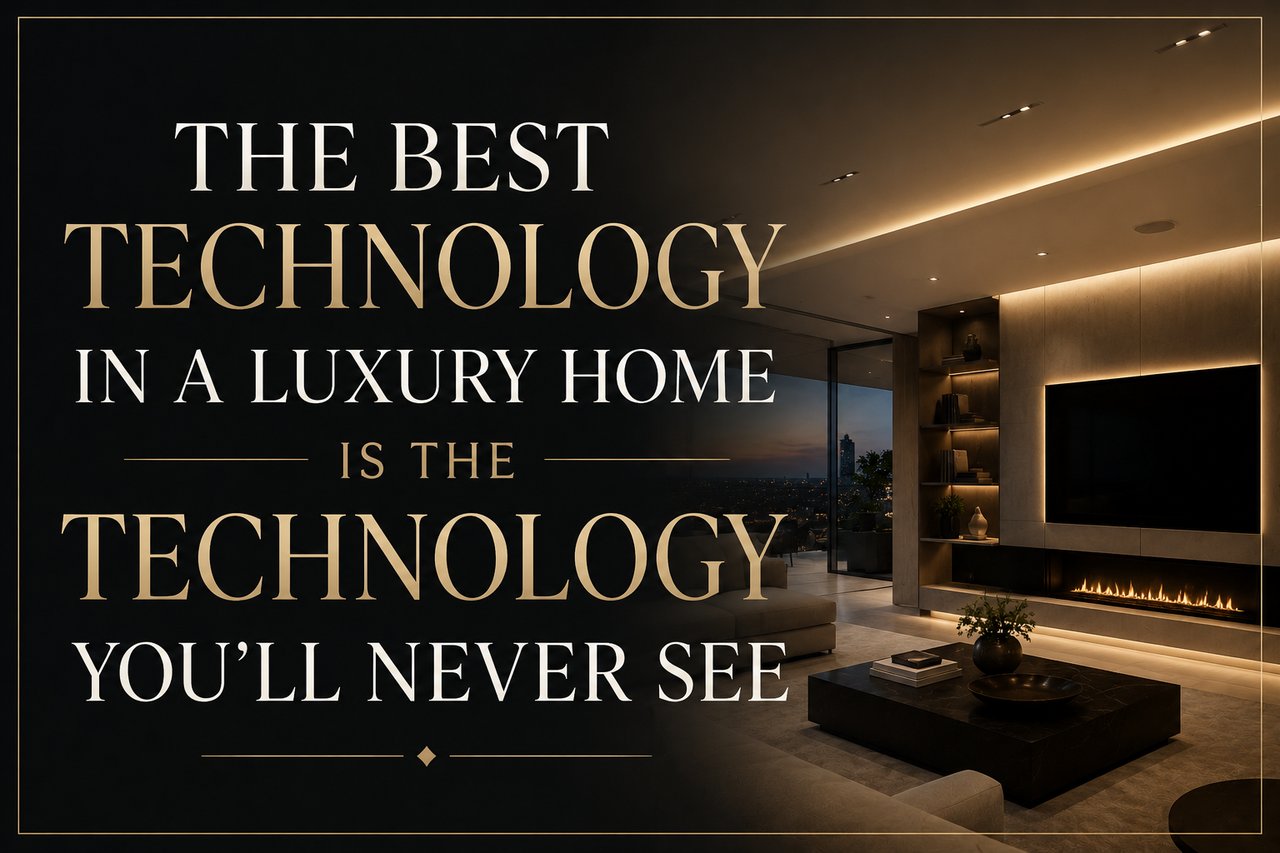
The defining design movement of 2026 is technology that disappears into the architecture.
Lighting is the clearest example.
Architectural—or "invisible"—lighting is peaking this year. Continuous runs of LED lighting are hidden inside ceiling coves, beneath floating vanities, behind custom headboards, and tucked beneath stair treads, allowing rooms to glow without a single visible fixture.
The same philosophy extends throughout the home. Televisions disappear into walls. Speakers blend into ceilings. Motorized shade pockets are framed into ceiling reveals during construction, making the shades virtually invisible until they're needed.
Some homes are now incorporating presence-sensing radar and haptic surfaces, allowing homeowners to wave a hand over a marble island to dim lights or adjust music.
No screen.
No app.
No clutter.
The reason this reads as luxury is simple: anyone can buy a device. Making technology disappear requires design intent, planning, and craftsmanship.
And that's exactly what affluent buyers are paying for.
It's quiet luxury applied to the systems running the home.
The Numbers Back It Up
This isn't just an aesthetic preference. It's showing up in buyer behavior and property value.
Across recent national surveys, approximately 78% of buyers say smart-home features are important when shopping for a home. A majority—around 65%—say they're willing to pay more for properties with integrated systems.
On the value side, the National Association of Realtors has pointed to smart-home features potentially increasing resale value by around 5%, while some industry analyses place the upside closer to 10% when integration is executed exceptionally well.
At Los Angeles luxury price points, even a few percentage points can translate into a meaningful amount of money.
It's important to be precise here because statistics often get thrown around carelessly in real estate.
These figures reflect broad market trends and well-executed integration—not guarantees on individual properties.
A drawer full of disconnected gadgets doesn't move the needle.
A home where lighting, climate, audio, shading, and security operate as one seamless ecosystem is what commands a premium.
What This Means If You're Selling
If you're preparing a luxury home for sale, the lesson isn't to rush out and buy the newest devices.
It's the opposite.
Unify what you already have and make the hardware disappear.
Buyers don't want to manage four different apps to run one house. They want the shades to lower automatically at sunset, the lighting to warm naturally throughout the evening, and the entry system to recognize them without a second thought.
Most importantly, they don't want to think about the machinery behind it.
The best technology feels effortless.
Outdoor integration matters as well.
With Southern California's year-round indoor-outdoor lifestyle, discreet lighting and audio systems that blend into landscaping have become expected rather than optional.
Security Is Part of Invisible Luxury
Security has evolved alongside technology.
The highest-end buyers are increasingly focused on privacy, but they don't want their homes to feel like fortresses.
Modern luxury security comes in layers: biometric entry systems, AI-driven cameras, soundproofing, automated gates, and landscaping designed to block sight lines.
Everything works together.
Nothing calls attention to itself.
For the buyers writing the largest checks in Los Angeles, discretion isn't a feature.
It's the entire point.
The Bottom Line
The luxury home of 2026 is calmer, cleaner, and smarter than the homes being built just a few years ago.
Yet almost none of that intelligence is visible.
The market has increasingly decided that the highest form of technology is the kind you feel rather than see.
The homes generating the strongest response today aren't packed with gadgets. They're thoughtfully designed environments where technology quietly enhances daily life without becoming the focus.
I don't just list properties. I position them.
And in today's market, positioning a home around seamless, invisible technology rather than a collection of devices is one of the clearest ways to connect with the buyer who can truly appreciate—and afford—it.
If you're thinking about selling and want to understand which upgrades genuinely move value at your price point—and which ones don't—let's talk before you spend a dollar.
Amir Jawaherian
The Agency | Los Angeles
CA DRE# 01899893
[email protected]
(818) 561-1600