If you look at a Bel Air Estates address and assume the ZIP code tells you everything, you can miss what actually drives value. In this part of 90077, buyers and sellers are not really trading a generic neighborhood label. They are pricing land usability, privacy, views, architecture, and what the property can realistically become. If you want to understand why one estate commands a premium and another stalls, this is where to focus. Let’s dive in.
Bel Air Estates Is a Parcel Market
Bel Air Estates sits within the City of Los Angeles’ Bel Air-Beverly Crest community plan area on the southern slopes of the Santa Monica Mountains. City planning materials describe it as the original 1922 subdivision, with more than 80 irregularly sized parcels and streets that follow the hills instead of a simple grid.
That history still matters today. In practical terms, Bel Air Estates behaves more like a parcel-by-parcel market than a broad ZIP-code market. Two homes can share the same 90077 mailing area and still have very different value drivers because the land, access, and topography are not interchangeable.
Market-wide numbers are still useful for context. In March 2026, Realtor.com reported a median listing price of $6.499 million in 90077, with 168 homes for sale, 60 median days on market, and homes selling about 4.84% below asking on average.
Those figures show an active but selective market. They also confirm that broad pricing trends only tell part of the story in Bel Air Estates, where the real pricing power usually sits in the details of the parcel itself.
Land Usability Often Sets the Ceiling
Lot Size Is Only Part of It
A larger lot does not automatically mean a more valuable property in Bel Air Estates. The district includes irregular parcels and varied terrain, with flatter conditions toward the south end and steeper conditions to the north.
Because hillside development may be limited by geology and steepness, gross acreage can be less important than usable pad area. A site with a cleaner building envelope, better grading conditions, and easier driveway geometry may outperform a larger parcel with more constraints.
Slope and Access Matter More Than Many Expect
In a hillside market, how you reach the home matters almost as much as the home itself. If access is awkward, turning space is limited, or the approach feels compromised, buyers tend to notice that quickly.
That is why driveway layout, street relationship, and day-to-day usability can influence value in a major way. In Bel Air Estates, the land is not just the setting. It is part of the product.
Buildability Affects Buyer Confidence
Bel Air’s community plan area was largely built out by the postwar era, and the city adopted the Bel Air-Beverly Crest Hillside Construction Regulation district in 2017 to regulate construction in hillside areas. That means redevelopment or major renovation potential is part of how sophisticated buyers assess a property.
If the path to improvement looks straightforward, that can support stronger pricing. If the site appears more complicated from a geology, slope, or entitlement standpoint, buyers may price in that risk.
Privacy Is a Core Luxury Feature
Bel Air Estates has long been associated with seclusion. City survey materials note that many properties are screened by walls, hedges, fences, deep setbacks, or slope, which can limit what is visible from the public right-of-way.
That privacy is not just a lifestyle benefit. In this market, it is a measurable amenity that affects demand. Buyers often place real value on a property that feels removed from the street and offers a more controlled arrival experience.
Street Presence and Arrival Shape Perception
Some estates make a strong impression because the approach feels calm, intentional, and private from the moment you enter. Others lose momentum if the home feels exposed or the approach lacks a sense of separation.
In Bel Air Estates, that sequence matters. The ability to create a sheltered entrance, visual buffering, and a strong sense of retreat can support a premium beyond square footage alone.
Views Are Powerful, but Only the Right Views
Views have been part of Bel Air’s identity from the beginning. City planning materials note that streets were originally laid out to capitalize on mountain, city, and even sea views.
But in the upper tier of the market, simply having a view is not enough. Value usually rises when the view is well oriented, visible from the main living spaces, and works naturally with the home’s layout and surrounding massing.
Protected Views Carry More Weight
A dramatic outlook can influence pricing, but buyers also consider how secure that outlook feels over time. A view that reads as more usable and more naturally integrated into the house tends to hold more appeal than one that feels secondary or compromised.
This is one reason parcel-level analysis matters so much in Bel Air Estates. Two homes may both advertise views, yet the premium can be very different depending on orientation, privacy, and how the experience actually lives.
Architecture Still Moves the Market
Bel Air was originally conceived as an architecturally curated estate community. Planning materials describe early design oversight, architectural harmony, underground utilities, and planted streets, and they associate the district with architects such as Paul R. Williams, Wallace Neff, and Roland E. Coate.
That legacy continues to shape buyer perception. In a market like this, architecture is rarely just aesthetic. It affects how a property is positioned, how it compares to nearby estates, and how buyers judge long-term desirability.
Pedigree Can Support Premiums
Survey materials for the broader plan area also reference notable work by John Lautner, Richard Neutra, A. Quincy Jones, and others. Architectural styles identified in the area include Colonial Revival, Spanish Colonial Revival, Tudor Revival, French Revival, Mid-Century Modern, and Ranch.
For buyers and sellers, the takeaway is simple. The market often rewards homes with strong architectural identity, whether that means a well-preserved original or a high-quality newer residence that respects the site and scale.
Execution Matters More Than Labels
Not every renovation or rebuild earns the same response. Bel Air Estates is selective, and the market tends to distinguish between homes with coherent design and homes that feel disconnected from the parcel or overbuilt for the setting.
That is especially important in a buyer-leaning environment, where presentation and quality can shape the size of the buyer pool. At this level, buyers are usually comparing not just finishes, but also design logic and how well the home fits the land.
Outdoor Programming Is Part of Estate Value
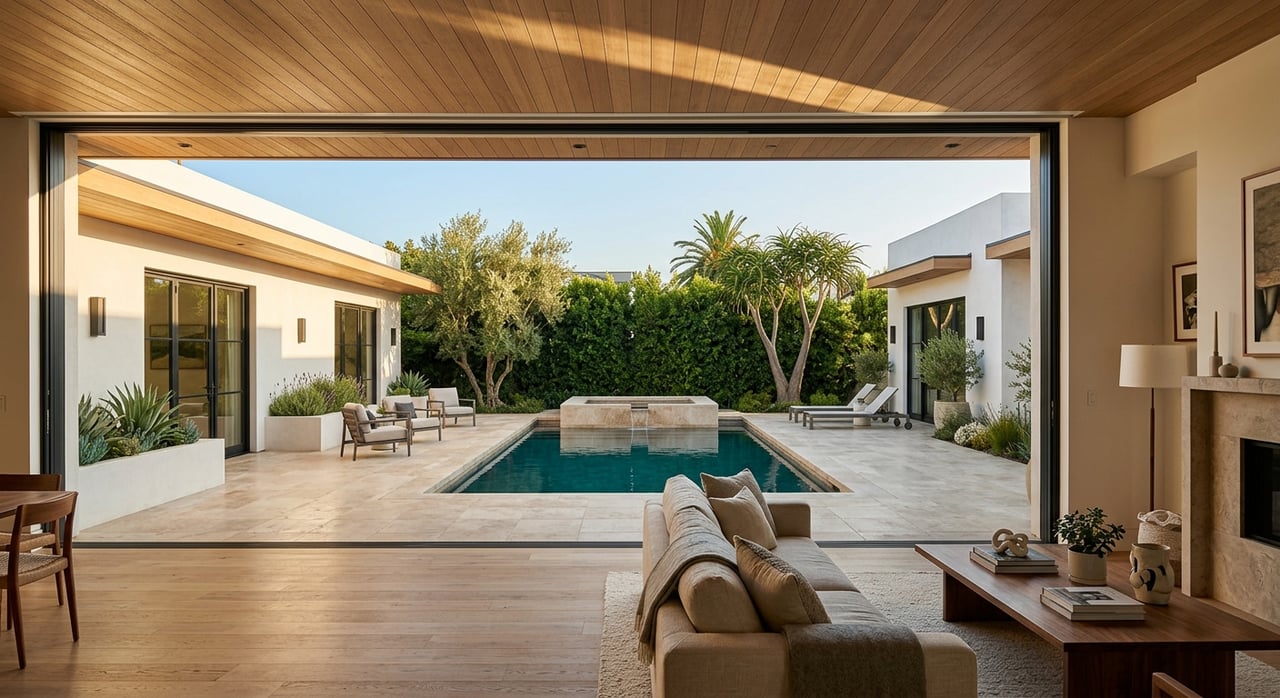
In Bel Air Estates, outdoor space is not an afterthought. Planning reports describe lots large enough to support lawns, gardens, pools, tennis courts, and ancillary structures, while SurveyLA notes that estates often include a main residence, guest house, pool house, detached garage, pool, tennis court, and landscaped grounds.
That means outdoor programming is part of the estate identity. Buyers often evaluate how well the land supports entertaining, recreation, and private open space, not just the interior square footage.
Usable Grounds Often Outperform Raw Land
A parcel with meaningful, functional grounds can be more compelling than one with more acreage but less practical outdoor use. Flat lawns, integrated pool areas, and usable terraces tend to carry more day-to-day value than space that exists mostly on paper.
This goes back to a core Bel Air Estates principle: usability matters. The strongest properties usually combine privacy, visual appeal, and outdoor function in a way that feels effortless.
Renovation Level Changes the Buyer Pool
City planning reports note that many original homes in Bel Air Estates have been demolished and rebuilt, and that smaller lots have sometimes been absorbed into adjoining parcels to accommodate larger homes. They also note that most buildable area in the broader community plan area had already been improved by 1972.
That context helps explain why renovation level matters so much today. A property that feels complete, consistent, and well finished will often attract a broader audience than one with dated interiors, deferred maintenance, or a remodel that feels out of step with the home or site.
Buyers Price in Friction
In a market where 90077 is currently buyer-leaning and homes are closing below asking on average, buyers tend to be disciplined about future work. If they anticipate deeper remodel costs or a more complicated redevelopment path, that usually affects what they are willing to pay.
For sellers, that does not mean every property must be fully reinvented before listing. It does mean the market tends to reward clarity, coherence, and realistic positioning.
How Bel Air Compares Nearby
Bel Air Estates shares some estate-market traits with nearby luxury districts, but the premiums are often shaped by smaller differences. Planning materials describe Holmby Hills in similar estate terms, including irregular parcels, winding streets, privacy walls, and lots large enough for lawns, pools, and tennis courts.
That overlap is exactly why broad prestige branding has limits. When buyers compare Bel Air to nearby trophy markets, they often end up focusing on the same fundamentals: access, privacy, view orientation, lot usability, and the quality of the home on the site.
Why Broad Comps Can Miss the Point
Realtor.com’s March 2026 snapshot showed Beverly Hills ZIP 90210 at an $8.85 million median listing price, with 278 homes for sale and 63 median days on market. Holmby Hills showed 12 homes for sale, a $3.845 million median listing price, and 50 median days on market.
These are useful reference points, but they are not perfect apples-to-apples comparisons. In Bel Air Estates, the more meaningful question is not which nearby area looks more expensive on paper. It is which specific parcel offers the strongest combination of privacy, utility, view, and architectural value.
What Buyers and Sellers Should Focus On
If you are buying in Bel Air Estates, look beyond the headline stats and study the parcel story. Focus on usable land, slope, access, privacy, view orientation, and how much confidence you have in the property’s current condition or future potential.
If you are selling, understand that buyers in this market are usually sophisticated and detail-driven. The strongest pricing arguments often come from showing why your property’s site, layout, privacy, outdoor program, and architectural execution are hard to replicate.
In other words, what really drives value in Bel Air Estates is not just prestige. It is the interaction of land usability, privacy, view protection, architecture, and the cost or risk of change. That is why pricing here requires more than a ZIP-code comp sheet.
If you are evaluating a Bel Air estate, land parcel, or redevelopment opportunity and want a discreet, development-informed perspective, Amir Jawaherian can help you assess the property through both a luxury brokerage and land-use lens.
FAQs
What drives home values in Bel Air Estates more than ZIP code averages?
- In Bel Air Estates, value is often driven more by parcel-level factors such as usable pad area, slope, privacy, access, view orientation, architecture, and buildability than by broad 90077 averages alone.
Does a bigger lot in Bel Air Estates always mean a higher value?
- No. Because parcels are irregular and hillside constraints can affect development, a smaller but more usable lot can be more valuable than a larger parcel with steeper or less practical conditions.
How important are views for Bel Air Estates property values?
- Views can be very important, especially when they are well oriented, visible from main rooms, and work naturally with the home’s privacy and overall site planning.
Why does privacy matter so much in Bel Air Estates real estate?
- City survey materials describe privacy features such as walls, hedges, deep setbacks, and hidden siting, and those characteristics are often treated as premium amenities in this market.
Do renovations increase value in Bel Air Estates homes?
- Renovations can support value when they are coherent, well finished, and appropriate to the site and scale of the home, but buyers may discount properties that appear dated, poorly updated, or more costly to improve.
How should buyers compare Bel Air Estates with Beverly Hills or Holmby Hills?
- Broad market data can offer context, but the most useful comparison usually comes from looking at each property’s land usability, privacy, access, views, and architectural quality rather than relying on prestige alone.